Why FinCEN’s 2026 Real Estate Rule Changes How Investors Structure Deals

For decades, one phrase carried a special kind of power in real estate:
“All-cash buyer.”
Fast closings. Fewer questions. Minimal scrutiny. And often, ownership hidden behind LLCs or trusts that revealed little about who actually controlled the property.
That era is changing.
Beginning March 1, 2026, the U.S. Treasury Department’s Financial Crimes Enforcement Network (FinCEN) implemented new Anti-Money Laundering regulations for residential real estate transfers – commonly called the Residential Real Estate Rule.
This replaces the prior regional Geographic Targeting Orders (GTOs) with a permanent nationwide reporting framework.
Despite the headlines, this rule is not aimed at ordinary homebuyers using traditional mortgages. Instead, it focuses on transactions involving entities, trusts, and certain non-bank financing arrangements frequently used by investors.
Here’s what actually matters.
Who This Rule Generally Does NOT Affect
Most retail buyers using conventional financing will see little change.
Traditional mortgages already fall under federal anti-money-laundering oversight. The new rule targets transactions where that oversight previously did not exist – primarily non-financed transfers involving entities or trusts.
What Triggers Reporting
A transaction may require reporting when:
- Residential real property is transferred,
- The buyer is a legal entity or trust,
- Financing does not come from a regulated financial institution, and
- A covered closing or settlement professional (the rule’s ‘reporting person’) participates in the transaction.
One important detail surprises many investors:
There is no minimum price threshold.
A multi-million-dollar acquisition and a nominal-value transfer between related entities may both qualify if the criteria are met.
Why Hard Money and Private Financing Are Treated Like Cash
Under the rule, a transaction is considered “non-financed” unless credit is extended by an institution already subject to federal AML compliance programs.
This means transactions using:
- hard money loans,
- private lenders,
- seller financing, or
- certain creative financing structures
may be treated the same as cash purchases for reporting purposes.
The reasoning is straightforward: banks already verify identity. Private lenders typically do not.
As a result, reporting responsibility shifts to the transaction itself.
The Reporting Cascade: Buyers Don’t File
The reporting obligation does not fall on the investor or buyer.
Instead, FinCEN assigns responsibility through a hierarchy known as the reporting cascade, typically involving:
- Closing or settlement agents
- Settlement statement preparers
- Deed recording professionals
- Title insurance underwriters
- Funds disbursement agents
- Title evaluators
- Deed preparers
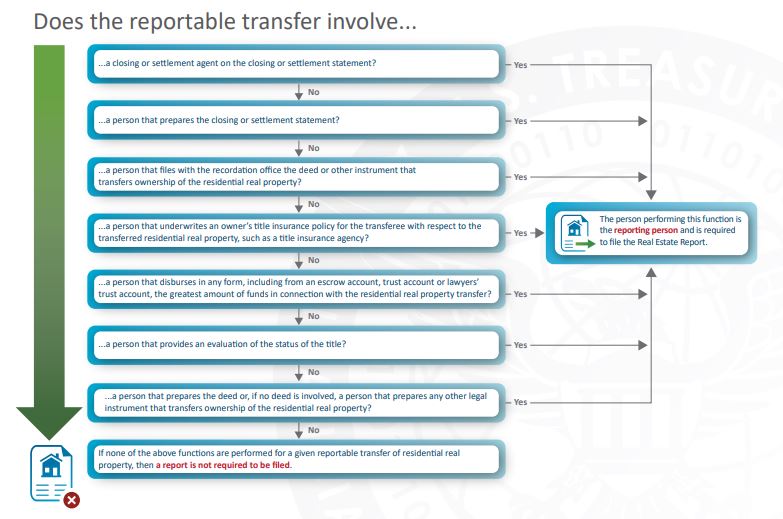
[Source: FinCEN.gov “Quick Reference Guide for Reporting Persons
https://www.fincen.gov/system/files/2025-12/QRG-Am-I-A-Reporting-Person.pdf]
Professionals may designate one filer, but responsibility must include the highest-ranking participant involved in the transaction.
In practice, this means closing professionals – not buyers – carry the filing obligation.
Beneficial Ownership: LLC Privacy Has Changed
The rule requires disclosure of beneficial owners, meaning the real individuals behind entity ownership.
Reporting includes individuals who:
- Own or control 25% or more of an entity, or
- Exercise substantial control, even without ownership.
For trusts, disclosure may extend to trustees, certain beneficiaries, grantors with revocation rights, and individuals exercising authority over trust assets.
Layered entity structures no longer prevent visibility when qualifying transfers occur.
Filing Deadlines and Enforcement
Reports must be submitted through FinCEN’s BSA E-Filing system by:
- 30 calendar days after closing, or
- the last day of the following month, whichever is later.
These filings are not public and are exempt from FOIA disclosure.
However, penalties for noncompliance can be significant, including civil penalties indexed under federal regulations and potential criminal exposure for willful violations.
What This Means for Real Estate Investors
The practical impact is less about compliance and more about expectations.
Entity Transfers May Create Records
Moving property between LLCs or restructuring ownership may now generate reporting events.
Private Financing No Longer Implies Privacy
Hard money and seller-financed deals may trigger reporting rather than avoid scrutiny.
Portfolio Restructures Leave Trails
Internal reorganizations may now create federal data records even when economic ownership does not change.
Closing Professionals Will Ask More Questions
Expect additional ownership documentation requests as industry participants manage their compliance risk.
The Bigger Shift: Transparency Is Assumed
Whether one agrees with the policy rationale or not, the operational reality is clear:
Real estate transactions increasingly operate under assumed transparency.
Good investing and sound entity planning still work.
Planning based on invisibility does not.
Final Thought
This rule represents a structural change in how residential real estate transactions are monitored nationwide.
The “all-cash advantage” still offers flexibility and speed, but anonymity is no longer part of that equation.
For investors, awareness now prevents surprises later – especially at the closing table.